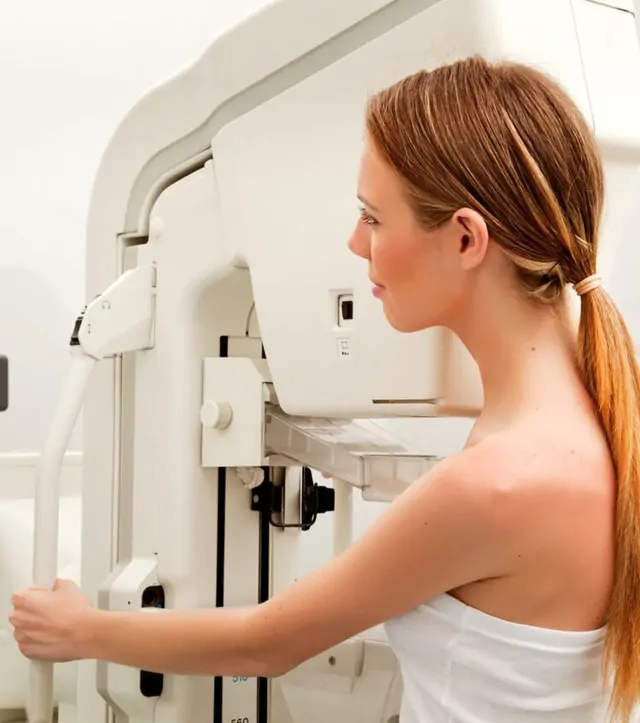
Why Digital Mammography?
2 min read
Digital mammography, like digital photography, has undeniably replaced older analog mammography systems with its undeniable advantages. The captured images can be stored and transferred digitally. Radiologists examine your mammograms in detail on special monitors with 4K resolution. Computer programs allow for the processing of images and adjustments without the need for re-exams.
The most significant advantage of digital mammography is its reduced radiation dose, up to 30%. Furthermore, the ability to more easily identify the first signs of cancer, known as "microcalcifications," in digital mammography at an earlier stage is a significant advantage. Furthermore, the compression of the breast, a common complaint among women, can be relatively lower with digital mammography. Due to these advantages, digital mammography is recommended for cases where evaluation is difficult, such as those with dense fibrocystic breasts or those with breast implants.
Tomosynthesis, described as the 3D equivalent of digital mammography, is a new technology. While it's a new method, its only difference from digital mammography is that images can be taken from different angles by moving the X-ray tube left and right, resulting in 3D images using mathematical calculations.
Some studies have reported greater sensitivity and increased cancer detection. The key point here is the increased radiation dose. If screening is performed solely with tomosynthesis, there is no increase in radiation dose. In other words, the radiation dose from tomosynthesis is the same as from regular digital mammography. However, if both digital mammography and tomosynthesis are performed, the radiation dose increases.
You should definitely discuss this with your radiologist. Performing your screenings with a single method will be more reliable in the long run. The most important advantage of tomosynthesis (3D mammography) is its use in detailed assessments to avoid unnecessary biopsies in cases where there is a conflict of interest.